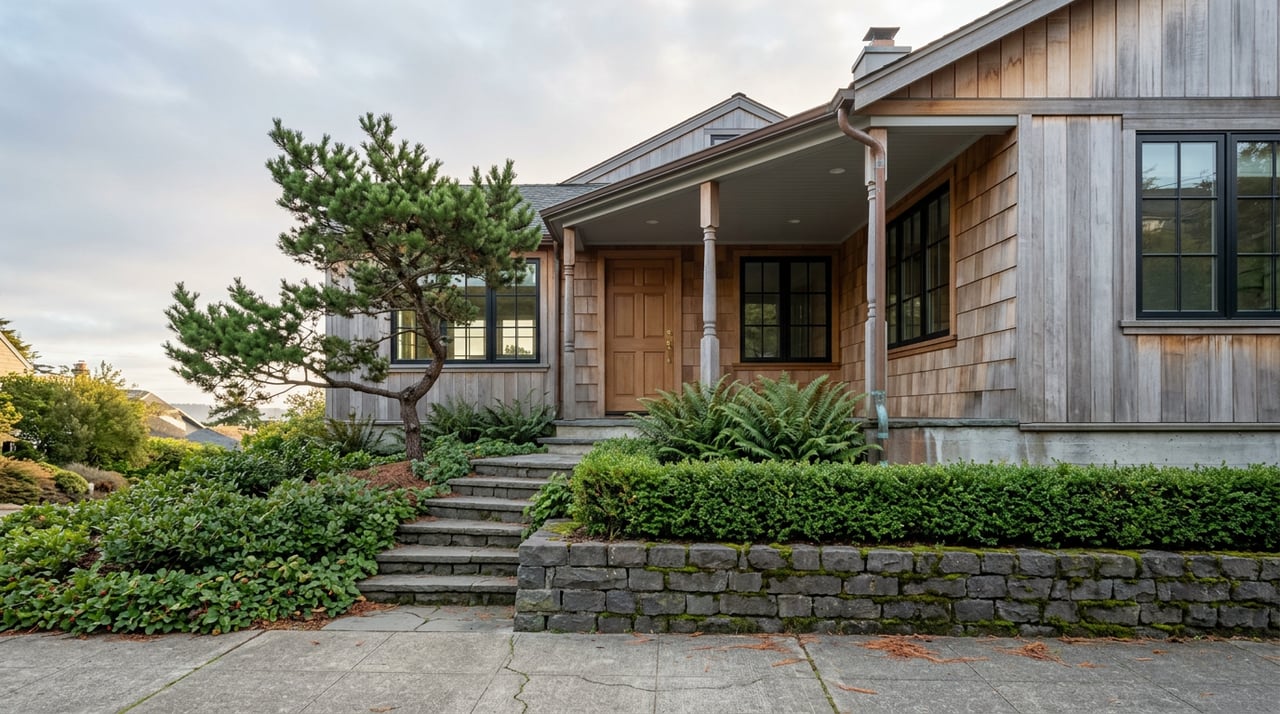
Astoria Oregon Home Prices by Neighborhood, Explained
September 3, 2026
September 3, 2026
Pull up three different home-price sites for Astoria in the same week and you will get three different answers to what should be a simple question. One index puts the typical home value at $486,000, down slightly over the past year. Another shows homes actually closing for a median of $516,000 over the spring into early summer, also down from a year earlier. A third shows homes listed to buy for $549,000 as of August. Same town, same summer, three numbers that do not sit close enough to call a rounding error.
If you are shopping in Astoria and trying to use a single median price as your anchor, this is the moment to stop. The number is not wrong exactly. It is measuring a town that does not behave like one market.
Part of the gap is simple definition. A "typical value" built from an automated valuation model is not the same thing as a median sold price pulled from closed transactions, and neither is the same as a median list price, which only tells you what sellers are asking, not what buyers are paying. Compare those three measures across any city and you will see daylight between them. Astoria's daylight is unusually wide.
The bigger reason is volume. Redfin's tally showed 37 homes sold in Astoria in June 2026, down slightly from 39 the year before. That is not a market with enough transactions to smooth out its own edges. In a city where a few hundred homes trade hands across an entire year, a single month's median can swing hard depending on whether that month happened to include a restored river-view Victorian in Astor Heights or a batch of modest flatland bungalows. Neither sale is wrong. Neither is representative. Both get folded into the same "median" as if they came from the same shelf.
Contrast that with Seaside or Gearhart, where price mechanics tend to run through zoning, specifically who can hold a short-term rental permit and who cannot. Astoria's price mechanics run through something else entirely: elevation and era of construction. This is a working river town with a year-round population, not a seasonal second-home market, and its housing stock reflects that history rather than a resort calendar.
Astoria's housing stock skews heavily toward homes built before 1960, and the city holds one of the largest concentrations of National Register properties of any city in Oregon. That history is not spread evenly. It climbs.
Uniontown, west of downtown below the Astoria-Megler Bridge, holds a mix of Victorian and early-20th-century single-family homes and has historically been one of the more accessible entry points into the Astoria market, though buyer interest there has been building. Astor Heights and the hillside neighborhoods above downtown carry the homes built during the salmon canning boom, many with direct Columbia River views, and tend to draw the fastest offers when priced well. Alderbrook and the flatter ground to the south and east price lower than the hillside as a rule, which in turn draws first-time buyers and value-conscious move-up buyers who are effectively priced out of the view lots.
The dollar spread across these pockets is wide enough to make a single citywide median almost meaningless for planning a purchase. Entry-level cottages and pre-1950s bungalows away from the waterfront can start around $300,000 to $350,000. Move to a fully renovated Victorian in Alderbrook, or anything with a wraparound porch and a Columbia panorama, and the same city produces homes in the $600,000 to $800,000 range. At a rough $300 per square foot, that median-level budget buys something specific: a roughly 1,600-square-foot historic bungalow or Craftsman, likely with a steep driveway and a view that makes you forget about it.
Even within one neighborhood, on one block, two homes with nearly identical square footage can land in different price tiers because of a factor that has nothing to do with size. Astoria's Victorian stock is old enough that condition, not layout, tends to be the swing variable in what a home actually sells for. A house with restored mechanical systems, original woodwork intact, and updated wiring and plumbing will sell meaningfully faster and for meaningfully more than a comparable one with deferred maintenance, even sitting on the same street.
This matters more in Astoria than in a newer-construction market because so much of the inventory predates modern building codes by decades. The city participates in the Certified Local Government program through the National Park Service and the Oregon State Historic Preservation Office, which shapes how some of these older homes can be renovated, particularly anything visible from the street in a historic district. That is worth understanding before you fall for a Victorian that needs work. A cosmetic fix and a structural or systems overhaul are different budgets entirely, and the exterior changes you are picturing may need to go through a review process before they happen. You can see how the city frames that process on its own historic preservation page.
If you are trying to use a portal's median price to gauge whether Astoria fits your budget, the number is doing you a disservice. The better question is not "what is the median" but "what does this specific hill, this specific decade of construction, and this specific level of upkeep actually buy me."
For a buyer prioritizing walkability and character at a more accessible price, Uniontown and parts of Alderbrook are worth watching closely, understanding that Uniontown in particular has been drawing more attention than it used to. For a buyer prioritizing river views and willing to pay for restoration already done, the hillside neighborhoods and Astor Heights are where that inventory concentrates, generally above $600,000. For a buyer weighing a fixer-upper Victorian against a modest updated bungalow, the math should include the ownership stack beyond the purchase price: property insurance in a coastal county, the real cost of deferred maintenance on pre-war construction, and, if a Portland connection matters to your life, the roughly two-hour drive each way along US-30.
None of this is a reason to avoid Astoria. It is a reason to stop treating the city as a single market with a single price tag and start treating it as several small markets stacked by elevation, each with its own logic.
Is Astoria's home price actually falling in 2026? Depends on which measure you trust and which month you catch. A sold-price median can dip year over year in the same stretch that a broader coast-wide report shows appreciation, because the mix of homes that happened to close shifted rather than because every home lost value. With as few as three dozen closings in a typical month, one unusually cheap batch of sales or one unusually expensive one can swing the headline number without reflecting what a specific well-maintained home in a specific neighborhood is actually worth.
Which Astoria neighborhood holds value best over time? South Slope and Alderbrook have historically shown some of the strongest long-term appreciation in the city, though both still carry a range of inventory rather than a single price point, so the neighborhood name alone is not a guarantee.
Does a lower price in Alderbrook or South Astoria mean something is wrong with the area? Not necessarily. Those neighborhoods sit on flatter ground without the river views that command a premium on the hillside, which is a geography question more than a quality one. That price gap is exactly what draws steady demand from buyers who want an Astoria address without competing for view-lot pricing.
Astoria rewards buyers who look past the headline number and ask what a specific street, a specific build year, and a specific condition actually deliver. If you are trying to make sense of which hill fits your budget and your plans, or you want a second opinion before you make an offer on a Victorian that needs work, I would be glad to walk it through with you. Jenny Frank has spent years pricing homes across Astoria, Gearhart, Seaside, Cannon Beach, and the surrounding North Oregon Coast, and knows which numbers to trust and which ones need a second look. Let's Connect.
This article is general information, not legal, tax or financial advice. Consult a qualified professional about your situation.
Stay up to date on the latest real estate trends.
Whether you’re buying or selling along the Oregon Coast, Jenny Frank provides expert guidance, local insight, and personalized service every step of the way.