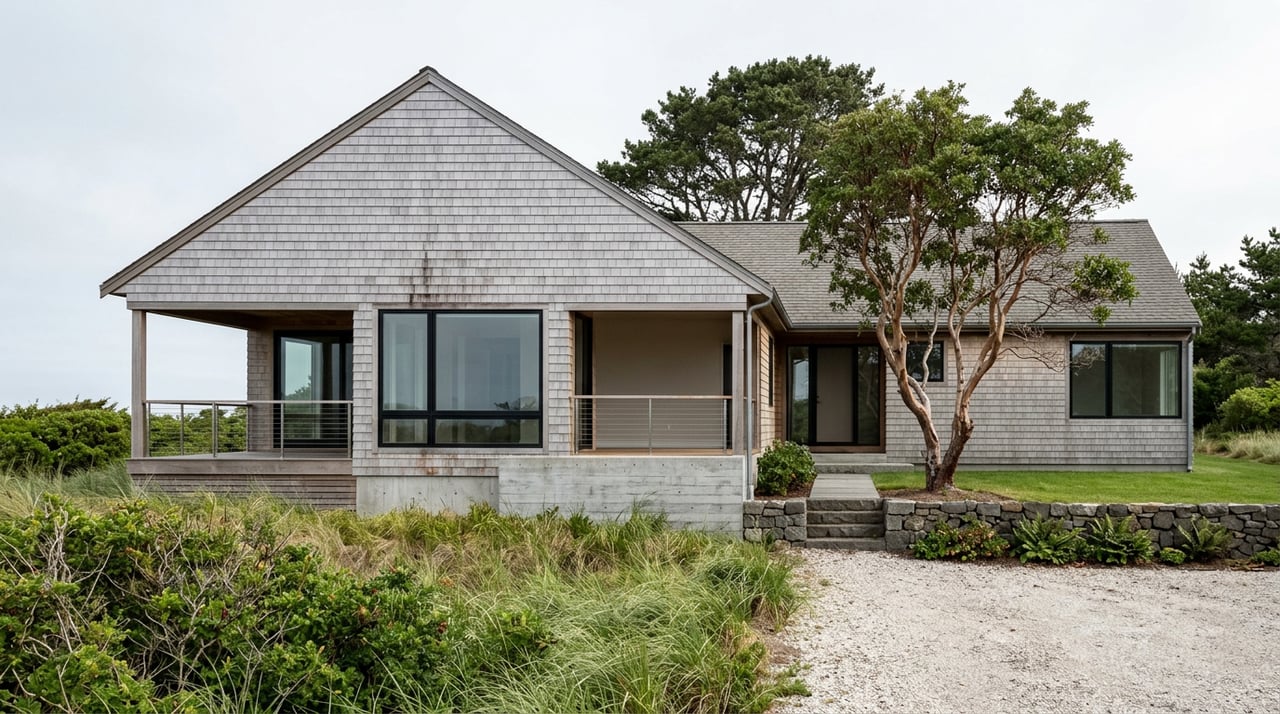
Cannon Beach's Vacancy Rate Isn't a Housing Surplus. It's a Permit Waiting List.
September 10, 2026
September 10, 2026
A buyer looking at a listing in Cannon Beach this year will run into a strange contradiction before they ever tour a house. Pull up one portal and home values look like they're climbing. Pull up another and the median price has dropped by a third. Ask a local why so many houses on a quiet street sit dark most weeks, and the answer isn't decline. It's ownership structure. Cannon Beach's housing stock behaves less like a typical residential market and more like a permit system with houses attached to it, and that system is being actively rewritten by the city council right now.
If you're comparing Cannon Beach against Gearhart, Seaside, or Manzanita, the number that actually matters isn't the median price on whatever site you happen to be looking at. It's whether the house you want comes with a short-term rental permit, and whether that permit survives the sale.
Three sources reporting on the same market in the same year told three different stories in 2026.
| Source | Metric | Figure | Direction |
|---|---|---|---|
| Zillow Home Value Index | Average home value, updated through June 2026 | $932,323 | up 2.5% year over year |
| Redfin | Median sale price, February 2026 | $590,000 | down 35.3% year over year |
| Movoto | Median list price, May 2026 | $998,000 | down 28% year over year |
None of these figures are wrong. They're measuring different slices of a market so thin that a handful of closings can swing the median by six figures. Cannon Beach is a town of roughly 1,400 to 1,600 year-round residents with a housing stock under 2,300 units, so a single month's sales might represent a dozen transactions, not hundreds. When a few high-end oceanfront closings land in the same reporting window as a cluster of smaller inland sales, the median jumps around in ways that would smooth out in a bigger market.
There's a second force compounding the noise: the buyer pool for income-producing coastal property has been narrowing as short-term rental rules tighten, and that shift shows up unevenly depending on which segment of listings closed in a given month. A price drop reported by one site in a given quarter may say more about which homes sold than about what the market as a whole is worth.
The number that surprises out-of-town buyers most is the vacancy rate. Depending on the dataset, a substantial share of Cannon Beach's housing units are reported as vacant. In a typical inland market, a vacancy level like that would signal an oversupplied or declining town. In Cannon Beach, it means something closer to the opposite.
The city's own planning department has tracked this directly. Its Housing Matters page notes that only 705 of the town's 1,888 total housing units were occupied by full-time residents, a loss of 7.1% in occupied housing over a single decade, even as new units continued to be added to the inventory. A more recent county-level inventory from April 2025 puts total housing units at 2,203, with 677 occupied and 1,526 reported vacant. Of that vacant total, 1,490 units are categorized as seasonal, recreational, or occasional use rather than sitting empty and unsellable.
This isn't a new development. A 2014 city housing task force found the same imbalance, with roughly 60% of homes already reported as second homes or vacation properties over a decade ago. Cannon Beach has functioned as a second-home market for a long time. What's changed is how the city is now trying to intervene in it.
Here's the detail that catches buyers off guard during a transaction, not before one: a short-term rental permit in Cannon Beach is attached to the person who holds it, not the property. The municipal code is direct about this. The Cannon Beach municipal code says the permit is void the moment the holder sells or transfers the property.
One category is especially relevant to buyers:
If a listing's marketing leans on rental income potential, ask whether it has an active short-term rental permit.
The council took up that exact question in a July 2025 work session, and the disagreement was pointed. Councilor Nancy McCarthy and Councilor Mike Benefield argued that unlimited rentals in residential neighborhoods create real livability strain.
"When it's unlimited, you're basically running a motel in a residential neighborhood."
That was Benefield's framing during the discussion, reported by the Tillamook Headlight Herald. Councilor George Vetter pushed back, warning that pulling permits out of the system entirely just drives rentals underground rather than eliminating them. The council left that meeting planning to revisit the ordinance again that fall.
Separately, the city has also been working through a broader cap on total short-term rental permits, a process that started with a July 2025 council session where members floated individual preferred numbers ranging from 125 to 195, before settling on an initial draft target of 165, down from roughly 195 permits active at the time, as the Cannon Beach Gazette reported.
The vacancy imbalance hasn't gone unnoticed at the policy level. In July 2026, the Cannon Beach City Council adopted a resolution launching a partnership with Placemate under a program called Lease to Locals, aimed at converting some of that vacant housing stock into long-term rentals for the local workforce. The Daily Astorian reported that city leaders framed it as one piece of a larger problem, not a fix on its own.
"We will not know if [Lease to Locals] works in a community like Cannon Beach until we try," said Councilor Hayes, according to that reporting, who also cautioned that without further action, the town risks becoming almost entirely a community of second homes and retirees.
That framing matters for anyone deciding whether to buy here. The vacancy rate isn't a temporary market condition waiting to correct itself. It's the outcome of decades of second-home demand meeting a fixed, small land area, and the city's current response is aimed at chipping away at the edges of that imbalance, not reversing it.
If you're weighing Cannon Beach against Gearhart or Seaside on the strength of a median price you saw on a portal, you're comparing numbers that may not mean what they appear to mean. A few things worth doing instead:
Ask directly whether a listing carries an active short-term rental permit. A permit does not automatically transfer at closing.
Treat any single month's median price with some skepticism given how few transactions move it. Look at trend over several quarters rather than one data point, and expect the number to keep moving as the buyer pool for income-producing property continues to narrow under the city's evolving rules.
Understand that a high vacancy rate here reflects a second-home economy, not a warning sign about resale value or market health. It has been true for over a decade and is unlikely to reverse regardless of what the Lease to Locals program accomplishes.
Does this specific property currently hold an active short-term rental permit? Verify this directly with the city's Community Development Department rather than relying on a listing description. Permits are tied to the current owner and typically don't survive a sale.
If there's no permit now, can I apply for one after closing? Ask the city about current permit availability and application requirements.
Why do median price reports for the same month disagree across sites? Small transaction volume. A handful of closings can shift the median substantially in either direction, so no single monthly figure should be treated as a definitive read on the market.
Cannon Beach rewards buyers who do the homework a portal listing won't do for them. If you want a straight read on what a specific property's rental history and permit status actually look like before you make an offer, Jenny Frank has spent years working these details out with buyers across Cannon Beach, Gearhart, and Seaside. Let's Connect.
This article is general information, not legal, tax or financial advice. Consult a qualified professional about your situation.
Stay up to date on the latest real estate trends.
Whether you’re buying or selling along the Oregon Coast, Jenny Frank provides expert guidance, local insight, and personalized service every step of the way.